
This is the first installment in my “Case For…” series in which I look at the underlying factors as to why some cities should receive more serious consideration for non-stop international service.
First up…
Columbus, Ohio

You might be thinking “Columbus? This guy’s out of his mind!” But let me explain. For starters, lets look at some cold, hard numbers.
Population: 860,000+ (14th largest in United States). Columbus has a greater population than the following cities, all of which already sustain regular non-stop transatlantic and/or transpacific service:
- Charlotte (17th): American, Lufthansa
- Seattle (18th): All Nippon Airways, Asiana, British Airways, Condor, Delta, Emirates, EVA Air, Hainan Airlines, Icelandair, Korean Air, Lufthansa, Norwegian, Thomas Cook, Virgin Atlantic.
- Denver (19th): British Airways, Edelweiss Air, Icelandair, Lufthansa, Norwegian, United.
- Washington D.C. (21st): Aer Lingus, Aeroflot, Air China, Air France, Air India, All Nippon Airways, Austrian Airlines, British Airways, Brussels Airlines, Emirates, Etihad, Icelandair, KLM, Korean Air, Lufthansa, Qatar Airways, Royal Air Maroc, Saudia, SAS, South African Airways, Turkish Airlines, United, Virgin Atlantic.
- Boston (22nd): Aer Lingus, Air Berlin, Air Europa, Air France, Alitalia, American Airlines, Azores Airlines, British Airways, Cathay Pacific, Delta Air Lines, El Al, Emirates, Hainan Airlines, Iberia, Icelandair, Japan Airlines, Lufthansa, Norwegian, Primera Air, Qatar Airways, SAS, Swiss, TAP Portugal, Thomas Cook, Turkish Airlines, Virgin Atlantic, WOW air.
- Detroit (23rd): Air France, Delta, Lufthansa, Royal Jordanian.
- Atlanta (38th): Air France, British Airways, Delta, KLM, Korean Air, Lufthansa, Qatar Airways, Turkish, Virgin Atlantic.
- Raleigh (41st): American Airlines, Delta.
- Miami (42nd): Aeroflot, Aer Lingus, Air Berlin, Air Europa, Air France, Alitalia, American Airlines, Austrian Airlines, British Airways, El Al, Eurowings, Finnair, Iberia, KLM, Lufthansa, Qatar Airways, SAS, Swiss, TAP Portugal, Thomas Cook, TUI Belgium/Netherlands, Turkish, Virgin Atlantic, WOW air, XL Airways France.
- Minneapolis (46th): Air France, Condor, Delta, Icelandair, KLM.
Economy: The Greater Columbus Area contains the following Fortune 500 companies:
- Cardinal Health (15)
- Nationwide Insurance (68)
- American Electric Power (167)
- L Brands: Includes brands like Victoria’s Secret, Bath and Body Works, Pink and more. (220)
- Big Lots (495).
Outside of the Fortune 500, the following notable companies maintain their headquarters in the Greater Columbus region.
- Ohio Health
- Huntington Bancshares
- Battelle
- Grange Insurance
- Wendy’s
- Abercrombie and Fitch
- Red Roof Inn
- Rogue Fitness
- SafeAuto Insurance
- Scotts Miracle-Gro
- Worthington Industries
In terms of per capita income, Columbus ranks 38th in the country at roughly $23,000 per person. This is ahead of metropolitan statistical areas that sustain regular non-stop transatlantic service like San Diego, CA (42nd, $22,926), Philadelphia-Camden-Atlantic City, PA (42nd, $22,873), Detroit-Flint-Ann Arbor, MI (47th, $22,319), Phoenix-Mesa, AZ (59th, $21,907), and Tampa-St. Petersburg-Clearwater, FL (65th, $21,784).
While Columbus’ per capita income is also higher than metropolitan areas like Houston, Orlando, Las Vegas, Los Angeles, and Miami-Fort Lauderdale, this needs to be taken with a grain of salt. These areas have underlying factors as to why they may have a lesser GDP despite being a larger city or why they may have already attracted non-stop international service.
Example #1: A greater population means that there is a greater likelihood that there are “stragglers” (people who underperform economically). In essence, as a population rises, so do the underperformers, who can drag down statistical areas.
Example #2: Cities like Orlando and Las Vegas have outside attractions that have wooed airlines into commencing international service. These cities could not sustain non-stop international flights to Europe and Asia on their own. Instead, attractions like the Las Vegas Strip (i.e. casinos/gambling) and DisneyWorld entice foreign carriers to start service. I mean really… it is crazy to think that Hainan and Korean Air fly to Las Vegas, while Emirates flies to Orlando. Go figure.
Location:
Columbus is very centrally located in Ohio.
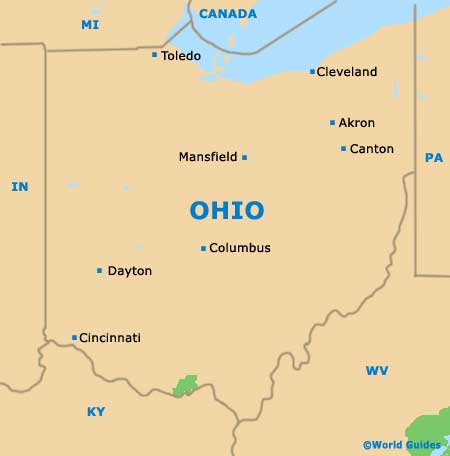
Both Cincinnati and Cleveland are roughly a 2 hour drive from CMH. In theory, 2 hours is about the limit for someone to drive in order to cut out a connecting stop. So adding non-stop international service to a city like London from CMH could attract people from both CLE and CVG and unite Ohio’s three “Big C’s” around 1 international port.
Even if we disregard the “Big C’s”, we can consider cities like Dayton, Akron, and Canton and their citizens as possible customers for a non-stop international flight. These second tier Ohio cities also fall within the 2 hour range from CMH. Personally, I have driven 2 hours to cut out a connecting flight, and I believe Ohioans would do the same. A 2 hour drive to CMH looks better than a connection in ORD between the month of November-March. Yes, Ohio gets snow. But having to accommodate 1 international flight (CMH) instead of 15 (ORD) during “irr-ops” is a much more manageable situation.
Summary:
I am no industry expert. I am not calculating the fuel burn per seat of a 767-300ER if it took off from London with a 9 mph headwind at 10:00 am in July and landed in Columbus at 2:03 pm. I am just looking at the basic facts and industry trends.
With that said, we can conclude a few concrete facts.
- Being the 14th largest city in the United States is nothing to wag your finger at. I bet my as* a city with that kind of size can sustain a 3x-5x weekly flight to a destination like London (especially if the flight was operated by a “long and thin” aircraft like the small yet fuel efficient 787-8).
- Columbus is centrally located. It has the ability to attract travelers from outlying cities who value the convenience of a direct flight.
- There is a steady “pull” and “push” of travelers. By pull, I mean there are factors attracting and pulling travelers to the area. Therefore, push insinuates that there is origin demand from Ohio for non-stop international service. We can conclude that the pull and push factors for Columbus are namely higher educational institutions (Ohio State University, Denison University, Kenyon College, and Ohio Wesleyan University) and large corporations with headquarters in the area (Nationwide Insurance, Cardinal Health, Huntington, Wendy’s, L-Brands, Abercrombie and Fitch, AEP…)
To the Point!
Don’t sleep on “C-bus”. The numbers are there (both physically and economically) and the city continues to grow. It was recently awarded a $50 million smart city grant (beating out 77 other cities) to improve transportation across the board. In essence, the city is on the up-and-up. Don’t be surprised if you see one of these on short final into John Glenn International in the near future…

Alright fine. I’ll even settle for one of these…

or these…

 Route Guide